
.png) Industry News
Industry News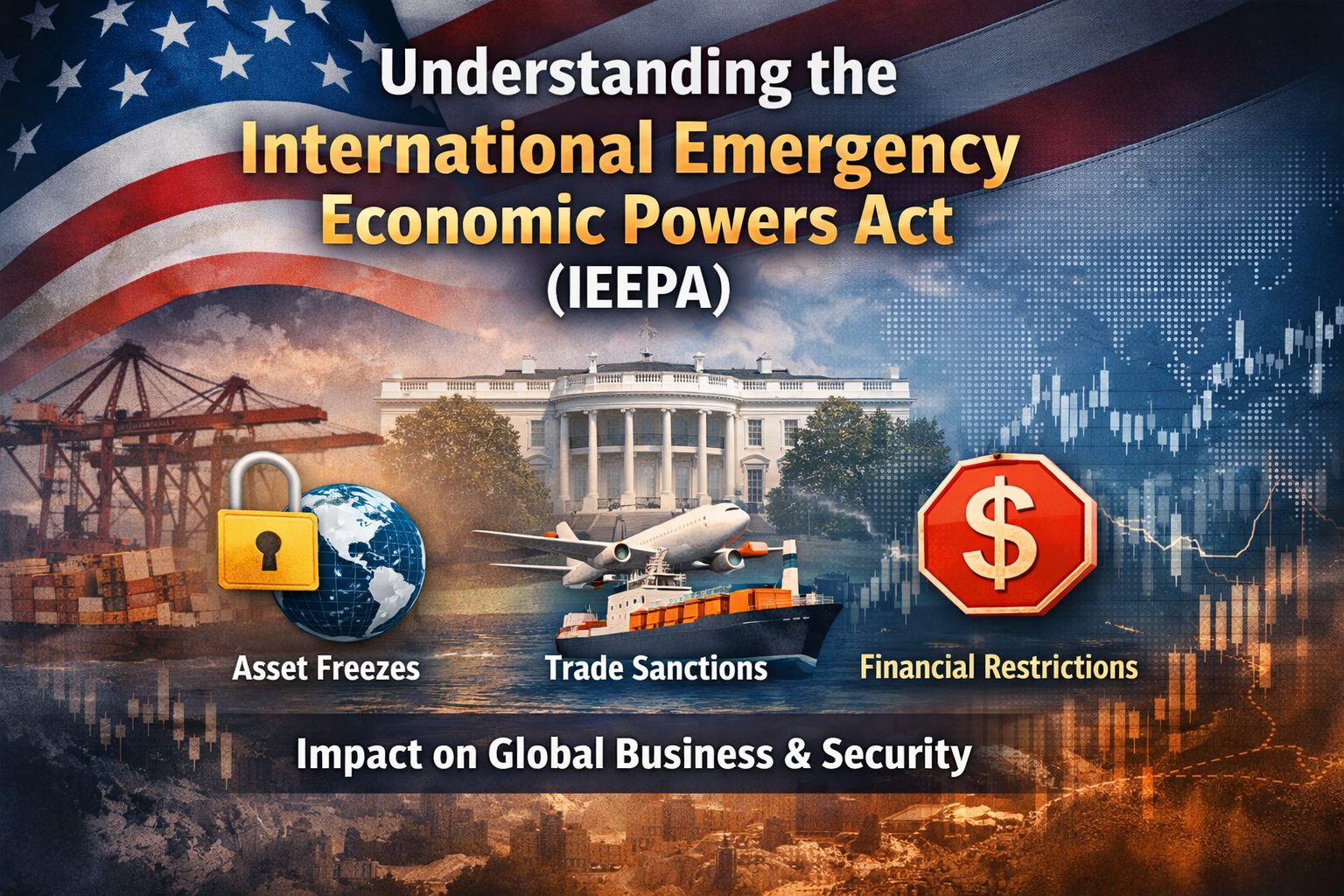
If you source products internationally, work with overseas manufacturers, or hold government contracts, there's a federal law that has quietly governed the rules of your business for decades — and in the past 13 months, it became front-page news.
The International Emergency Economic Powers Act, or IEEPA, has been at the center of the most significant U.S. trade policy upheaval in a generation. Understanding what it is, how it was used, and what just happened to it in the courts is no longer just a legal curiosity. It's practical knowledge for anyone managing a global supply chain in 2026.
What Is IEEPA?
IEEPA is a U.S. federal law passed in 1977 that gives the President broad authority to regulate international commerce when a national emergency has been declared involving a foreign threat. That threat can relate to:
Once an emergency is declared, the President can restrict or block virtually any international economic transaction — imports, exports, financial transfers, investments, and more.
IEEPA is powerful because it moves fast. Unlike legislation that requires congressional debate and approval, IEEPA lets the executive branch act by executive order, often overnight.
How IEEPA Is Enforced
In practice, most IEEPA actions are implemented through the Office of Foreign Assets Control (OFAC), an arm of the U.S. Department of the Treasury. OFAC maintains and enforces a series of sanctions programs targeting specific:
If your business — or any supplier, partner, or customer in your supply chain — appears on an OFAC sanctions list, transactions with that party are prohibited. The consequences of non-compliance are serious: civil penalties, criminal charges, loss of government contracts, and significant reputational damage.
The practical takeaway: Every company involved in international trade needs a process for screening its supply chain against OFAC's Specially Designated Nationals (SDN) list and other restricted party lists. This isn't optional, and it isn't just a large-company concern.
IEEPA's Traditional Role: Sanctions Programs
For most of its history, IEEPA was used primarily for targeted sanctions — blocking specific bad actors from accessing the U.S. financial system and economy. Well-known examples include:
Iran: Comprehensive sanctions have been in place for decades, covering financial transactions, oil imports, and dealings with Iranian government entities.
North Korea: Broad sanctions restrict nearly all trade and financial activity involving North Korea or its government.
Russia: Following the 2022 invasion of Ukraine, the U.S. significantly expanded IEEPA-based sanctions on Russian banks, oligarchs, and state-owned entities.
These programs are still fully in effect today. If your supply chain touches any of these regions — or involves companies with ownership ties to sanctioned parties — OFAC compliance is a live issue for your business.
2025–2026: IEEPA Used in an Unprecedented Way
Here's where the story gets both more complicated and more relevant to anyone sourcing from Asia, Mexico, or Canada.
On February 1, 2025, President Trump invoked IEEPA to impose tariffs on Canada, Mexico, and China — something no president had ever done before. The law had always been used for sanctions. Using it to impose broad import tariffs was a new and legally untested move.
Then in April 2025, the administration went further. Trump declared a national emergency over large and persistent U.S. trade deficits and used IEEPA to impose a minimum 10% reciprocal tariff on nearly all countries worldwide — a move he called "Liberation Day." At its peak, these tariffs represented the largest U.S. tax increase as a share of GDP in over three decades, and they hit virtually every global supply chain overnight.
For companies importing components from China, Taiwan, Malaysia, Vietnam, or other manufacturing hubs, the cost impact was immediate and significant — layered on top of Section 232 steel and aluminum tariffs and existing Section 301 duties on Chinese goods that were already in place.
The Legal Battle — and the Supreme Court's Verdict
The tariffs faced challenges in court almost from the day they were imposed. Both the U.S. Court of International Trade and the Court of Appeals for the Federal Circuit held that IEEPA did not authorize the tariffs, characterizing them as unbounded in scope, amount, and duration. The Supreme Court agreed to take up the case.
On February 20, 2026, the Supreme Court issued its ruling. In a 6-3 decision, the Court held that IEEPA does not authorize the president to impose tariffs — finding that Congress did not delegate tariff authority to the president under IEEPA, because the power to "regulate importation" cannot be read to include the power to tax.
All IEEPA-based tariffs imposed since February 2025 were invalidated.
What Replaced Them — And What's Coming Next
If you were hoping the Supreme Court ruling meant the end of elevated tariffs, the picture is more complicated.
Within hours of the decision, the president issued a new executive order imposing a 10% tariff on goods from all countries under Section 122 of the Trade Act of 1974, effective February 24, 2026. Section 122 is a different legal authority — one that allows temporary import surcharges. The catch: this tariff expires on July 24, 2026, and duties under Section 122 are capped at 15%.
To build something more permanent before that deadline, the administration moved quickly. On March 11–12, 2026, the U.S. Trade Representative launched Section 301 investigations into 16 economies for manufacturing overcapacity and 60 economies for forced labor practices. The list of targeted economies includes China, Taiwan, Malaysia, Vietnam, Japan, Mexico, and the EU — essentially the full map of global manufacturing.
Unlike Section 122, Section 301 tariffs have no expiration date and no cap. Treasury Secretary Bessent has publicly predicted that by August, tariffs will return to the levels that existed before the Supreme Court's ruling.
The bottom line for supply chain teams: The tariff environment has not stabilized. It has simply shifted legal vehicles. Companies that source internationally should expect continued uncertainty through at least mid-2026, with new tariff actions potentially taking effect in late summer.
What About IEEPA Tariff Refunds?
This is a question a lot of procurement and finance teams are asking right now, and the honest answer is: potentially yes, but it's complicated.
More than 330,000 importers made over 53 million entries subject to IEEPA tariffs. The Court of International Trade has ordered U.S. Customs and Border Protection to begin processing refunds, but CBP has indicated it needs approximately 45 days to build the necessary electronic systems — and refunds will only be issued via ACH, not checks.
The refund process is expected to cover entries that have not yet reached final liquidation. Entries that have already been finalized may face a narrower window through the formal protest process. Given the scale — an estimated $170 billion in IEEPA tariffs collected — the process will take time, and legal questions around eligibility are still being resolved.
If your company paid IEEPA tariffs between February 2025 and February 2026: Preserve all entry records, duty payment documentation, and internal cost allocation records. Consider consulting a licensed customs attorney or trade compliance specialist to evaluate your eligibility and timing.
Why This Matters for Companies in Government Contracting
For businesses holding federal or state government contracts, IEEPA compliance carries an additional layer of scrutiny. Government contractors are expected to maintain robust trade compliance programs — including regular screening of suppliers and subcontractors against OFAC sanctions lists. Failing to catch a sanctioned party in your supply chain can jeopardize contract renewals, trigger audits, and result in debarment.
This is true regardless of the tariff situation. Sanctions programs under IEEPA remain fully in effect. The Supreme Court ruling only addressed the use of IEEPA for tariffs — it did not touch the law's sanctions authority, which is unchanged.
Why IEEPA Compliance Matters for Your Business
For companies engaged in international sourcing, procurement, or government contracting, compliance with IEEPA regulations is critical. Failing to comply with sanctions programs can result in:
Businesses should implement strong compliance procedures, including screening suppliers, partners, and customers against sanctioned entity lists. For companies involved in global trade, understanding these regulations is not just a legal requirement — it's a cornerstone of responsible, sustainable business operations.
How 889 Global Solutions Helps You Navigate This
At 889 Global Solutions, regulatory complexity is part of what we manage on behalf of our clients every day. Our team actively monitors developments in trade law — including OFAC sanctions programs, tariff changes, and sourcing region risk — so that your procurement team isn't left scrambling to keep up.
A few things set our approach apart:
We act as your FDA-registered initial importer. 889 takes title and ownership of goods on your behalf, absorbing a layer of regulatory and compliance responsibility that most sourcing partners leave entirely with the client. You get the cost savings of international manufacturing without carrying the full burden of international procurement compliance alone.
Our supplier network is built on 20+ years of verified relationships. We work with vetted, audited factories across China, Taiwan, and Malaysia — partners holding ISO 9001, ISO 13485, and other relevant certifications. In a trade compliance context, knowing exactly who is in your supply chain, and being able to document it, is foundational to any sound OFAC screening program.
We understand what compliance-conscious procurement looks like. As an MBE/WBE-certified company, 889 operates with the rigor and documentation standards that regulated industries and procurement-focused clients expect. That discipline extends to how we manage sourcing on behalf of all our clients.
The tariff and regulatory environment is going to keep shifting. Having a sourcing partner who tracks it with you — and has the infrastructure to adapt — is one of the most practical risk management investments a supply chain team can make.
Ready to talk about your sourcing situation? Contact 889 Global Solutions for a sourcing review at https://www.889globalsolutions.com/company/contact-us
Key Takeaways
This post is for general informational purposes only and does not constitute legal or trade compliance advice. For guidance specific to your business, consult a licensed trade attorney or customs compliance professional.
.png)
.png)