
.png) Industry News
Industry News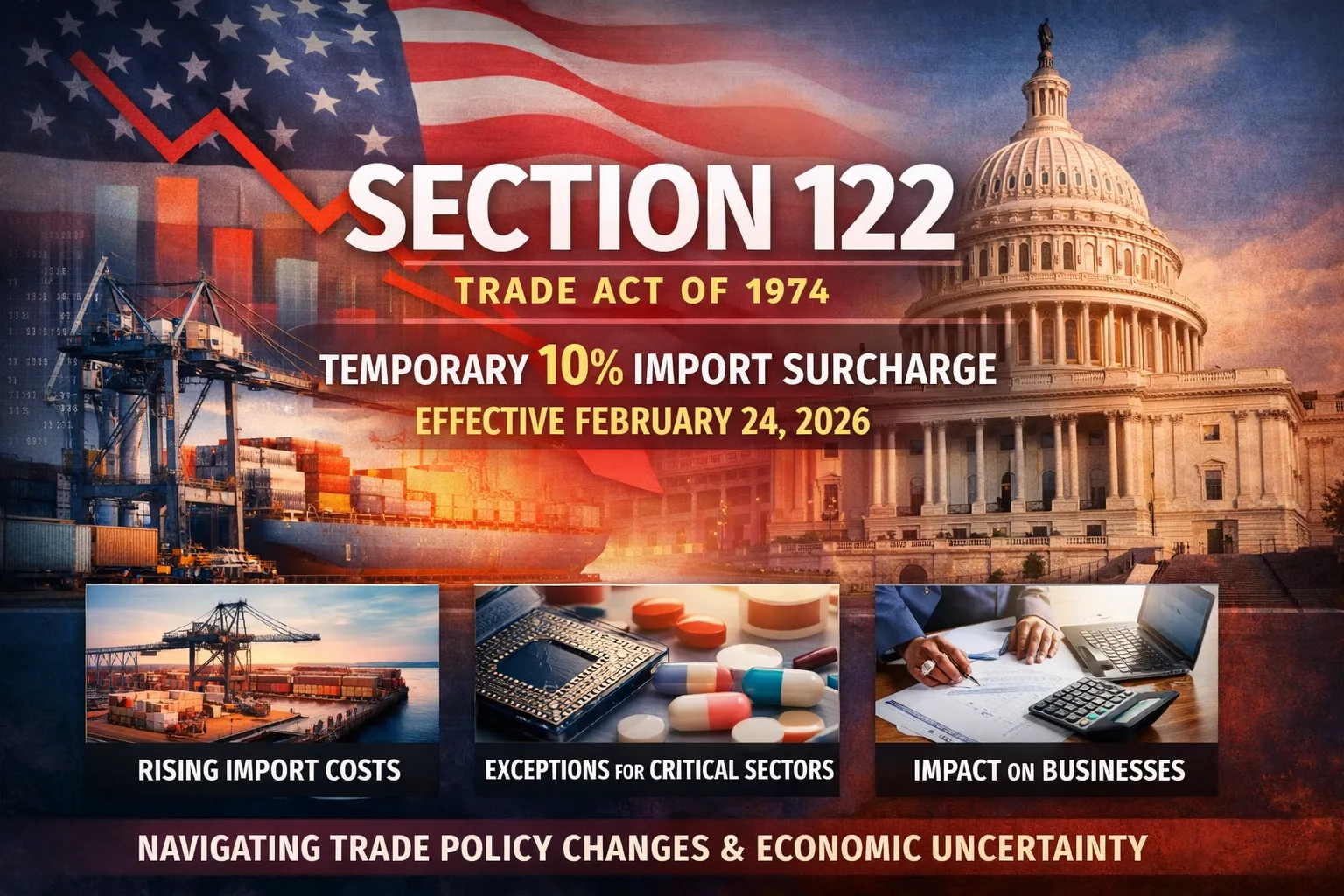
If you import goods into the United States, there's a new tariff sitting on top of your shipments — and it arrived with almost no warning.
On February 24, 2026, a 10% import surcharge took effect on most goods entering the U.S. under a legal authority called Section 122 of the Trade Act of 1974. It replaced a sweeping tariff regime that the Supreme Court struck down just four days earlier. The surcharge is temporary — but its expiration date is approaching fast, a potential rate increase is on the table, and legal challenges are already underway.
For businesses involved in global sourcing, procurement, or manufacturing, understanding what Section 122 is, why it was invoked, and what it means for your operations is urgent and practical — not just academic.
What Is Section 122 of the Trade Act of 1974?
Section 122 is a provision of U.S. trade law that gives the President authority to impose temporary import surcharges when the United States is experiencing what the law calls a "large and serious" balance-of-payments deficit — meaning the U.S. is spending significantly more on imports than it earns from exports and overseas investments.
Unlike IEEPA — which the Supreme Court recently ruled cannot be used for tariffs — Section 122 explicitly authorizes import surcharges. The tradeoffs are significant constraints:
Section 122 has existed in U.S. law since 1974 but had never been used before February 2026. Its invocation this year represents another historic first in a stretch of U.S. trade policy that has produced several of them.
Why Was Section 122 Invoked Now?
To understand why Section 122 is in play, you need to understand what happened the week before it took effect.
On February 20, 2026, the U.S. Supreme Court issued a 6-3 ruling in Learning Resources, Inc. v. Trump holding that the International Emergency Economic Powers Act (IEEPA) does not authorize the president to impose tariffs. That decision invalidated all of the IEEPA-based tariffs that had been in place since February 2025 — including the sweeping "reciprocal tariffs" on most of the world and the earlier tariffs on China, Canada, and Mexico.
Within hours of that ruling, the White House needed a replacement. Late on February 20, 2026, the president issued a proclamation establishing a temporary 10% ad valorem global import tariff under Section 122, effective February 24, 2026.
The administration cited the U.S. goods trade deficit — specifically the $1.2 trillion goods trade deficit, the first-ever negative balance on primary income in 2024, and a net international investment position of negative 90% of GDP — as the balance-of-payments justification required by the statute.
The practical reality: Section 122 was a legal tool of convenience invoked immediately after losing a Supreme Court case. The administration has been transparent that it views Section 122 as a temporary bridge while it builds more durable tariff authority through other mechanisms — primarily Section 301 investigations launched in March 2026.
What the Surcharge Covers — and What It Doesn't
The Section 122 surcharge applies broadly to most goods imported into the United States regardless of country of origin. However, a significant list of exemptions applies. For companies in manufacturing, procurement, and industrial sourcing, the most important exemptions are:
Goods already subject to Section 232 tariffs — Steel, aluminum, copper, lumber, automobiles, and certain vehicle parts are excluded from the Section 122 surcharge to the extent a Section 232 tariff already applies. These tariffs do not stack.
USMCA-qualifying goods from Canada and Mexico — Goods of Canada or Mexico entered free of duty under the U.S.-Mexico-Canada Agreement (USMCA) remain exempt from the surcharge. Companies sourcing from North American suppliers with proper USMCA certification are unaffected for those goods.
Certain critical minerals, energy products, and pharmaceuticals — These categories were carved out to avoid disrupting essential supply chains.
CAFTA-DR qualifying textiles and apparel — Goods from Costa Rica, the Dominican Republic, El Salvador, Guatemala, Honduras, and Nicaragua entering duty-free under the Dominican Republic-Central America Free Trade Agreement are exempt.
The practical takeaway for industrial and manufacturing companies: If you are importing steel, aluminum, or other metals already subject to Section 232 duties, the Section 122 surcharge likely does not add to your cost. If you are importing finished components, assemblies, or other manufactured goods from China, India, Vietnam, or Taiwan — and those goods are not covered by a Section 232 carve-out — the 10% surcharge applies on top of any existing duties.
The Rate Could Go Higher — But Hasn't Yet
The current operative rate is 10% — confirmed by U.S. Customs and Border Protection guidance issued February 23, 2026. But that may not be the final number.
The day after the surcharge was announced, President Trump posted on Truth Social that the rate would be raised to 15% — the statutory maximum under Section 122. Then on March 4, 2026, Treasury Secretary Bessent stated in a CNBC interview that the rate would increase to 15% "sometime this week." As of mid-March 2026, however, no formal proclamation or executive order implementing the 15% rate has been issued. CBP guidance continues to confirm the operative rate is 10%, reportedly due to complications around how the higher rate would interact with lower-tariff bilateral framework agreements already in place with certain trading partners.
For cost planning purposes, businesses should model for both the current 10% rate and a potential increase to 15%. The gap between those two scenarios — and the timing — remains uncertain.
The July 24, 2026 Deadline — and What Comes After
The surcharge is explicitly temporary: 150 days from February 24, 2026, expiring July 24, 2026 unless Congress extends it. This is the maximum period Section 122 permits without congressional action.
That creates a hard deadline the administration is working against. To replace the Section 122 surcharge with something more permanent before it expires, the U.S. Trade Representative launched two tracks of Section 301 investigations in March 2026 — one targeting 16 economies for manufacturing overcapacity, and another targeting 60 economies over forced labor practices. China, India, Vietnam, Taiwan, Japan, Mexico, and the EU are among the named economies.
Public comment periods for both investigation tracks close April 15, 2026. Hearings on the forced labor investigations are scheduled to begin April 28, and hearings on the overcapacity investigations begin May 5 — both at the U.S. International Trade Commission in Washington, D.C. After findings are issued, new Section 301 tariffs could be in place by late summer 2026.
Section 301 tariffs — unlike Section 122 — have no expiration date and no rate cap. Treasury Secretary Bessent has publicly predicted that by August, tariffs will return to the levels that existed before the Supreme Court's ruling.
The bottom line: The July 24 expiration date does not mean tariffs go away. It means they either get extended by Congress, replaced by Section 301 actions, or both. Companies should plan for continued elevated tariff costs through the end of 2026 and beyond.
The Legal Challenges Are Already Here
Section 122 is facing legal scrutiny from multiple directions.
On March 5, 2026, twenty-four states filed suit in the Court of International Trade to permanently block the Section 122 tariffs and recover duties already paid. On March 13, those states filed a motion for summary judgment — an aggressive procedural move signaling they believe the legal case is clear-cut and are pushing for a fast resolution. On March 9, a separate lawsuit was filed by private companies challenging the Section 122 tariffs on nondelegation doctrine grounds — arguing that Congress cannot delegate tariff authority to the president in this way — adding a second legal theory to the mix.
Until a court orders otherwise, the tariff is live and all shipments are subject to it. Businesses should not delay compliance action while waiting for legal outcomes — but they should preserve records of all duties paid under Section 122 in the event refunds become available, as they did with IEEPA.
Why IEEPA Sanctions Compliance Still Matters
It's worth being clear about what Section 122 did and did not change. The Supreme Court ruling and the Section 122 replacement affected only the tariff dimension of U.S. trade law. IEEPA's sanctions programs — covering Iran, Russia, North Korea, and other restricted parties — are entirely unaffected and remain fully in force.
For any company involved in international sourcing or procurement, OFAC sanctions compliance is a separate and ongoing obligation that runs parallel to tariff compliance. The two are distinct legal frameworks, and the recent tariff upheaval has no bearing on your sanctions screening obligations.
Why This Matters for Your Business
For companies engaged in international sourcing, procurement, or government contracting, the Section 122 surcharge has real and immediate cost implications. Failing to account for it — or failing to identify which of your goods qualify for exemptions — can result in:
Businesses should implement timely reviews of their import classifications, exemption eligibility, and supplier contracts. Building tariff adjustment clauses into procurement agreements is a practical step that many companies overlooked during the IEEPA period and are now addressing.
How 889 Global Solutions Helps You Navigate This
At 889 Global Solutions, we manage the complexity of global sourcing on behalf of our clients — and that includes staying current on the trade policy developments that affect your costs and compliance obligations.
A few things set our approach apart:
We act as your FDA-registered initial importer. 889 takes title and ownership of goods on your behalf, absorbing a layer of regulatory and compliance responsibility that most sourcing partners leave entirely with the client. You get the cost savings of international manufacturing without carrying the full burden of tariff and trade compliance alone.
Our supplier network is built on 25+ years of verified relationships. We work with vetted, audited factories across China, India, Vietnam, and Taiwan — partners holding ISO 9001, ISO 13485, and other relevant certifications. In a tariff environment that changes by the week, knowing your supply chain and having documentation to support exemption claims is essential.
We understand what compliance-conscious procurement looks like. As an MBE/WBE-certified company, 889 operates with the rigor and documentation standards that regulated industries and procurement-focused clients expect. That discipline extends to how we manage sourcing on behalf of all our clients.
The trade environment is shifting faster than most procurement teams can track. Having a sourcing partner who monitors it with you — and has the infrastructure to adapt — is one of the most practical risk management decisions a supply chain team can make.
Ready to talk about your sourcing situation? Contact 889 Global Solutions for a sourcing review at: Contact 889 Global Solutions | Get In Touch
Key Takeaways
.png)
.png)