

.png) Industry News
Industry News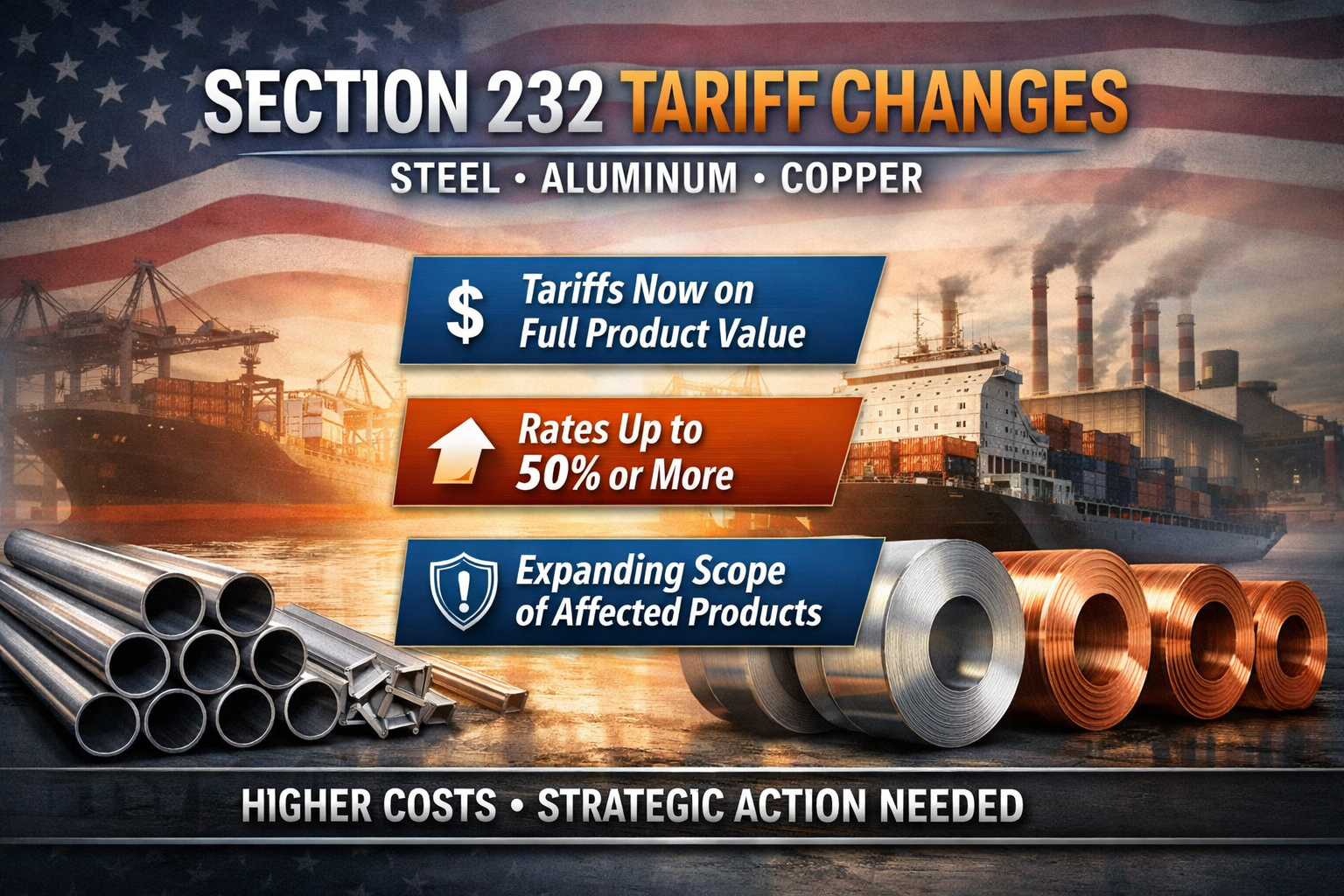
Section 232 Tariff Changes in 2026: What Procurement Leaders Must Do Now
If your supply chain depends on imported components—even indirectly—your cost structure may have just changed significantly. The latest updates to Section 232 tariffs on steel, aluminum, and copper don’t just raise rates—they change how tariffs are calculated, applied, and enforced.
For procurement managers and supply chain leaders, this is not a minor regulatory update. It directly impacts landed cost, supplier strategy, and margin protection.
Tariffs Now Apply to Full Product Value
One of the most important changes is how tariffs are calculated.
Previously, many imported products were assessed duties based primarily on the metal content within the product. That created opportunities to manage exposure through sourcing, design, or classification strategies.
Under the new rules, tariffs apply to the full customs value of covered products, not just the metal portion. This applies to aluminum, steel, and copper articles and derivative products that fall within the defined tariff scope and classifications.
The key takeaway: If your product falls within scope, the entire declared value—not just metal content—is now subject to tariffs.
This is a significant shift. Assemblies, subcomponents, and finished goods that include these metals may now carry substantially higher duties than before. The impact is especially pronounced for higher-value products where metal is only one component.
It also increases the importance of accurate HTS classification. Whether a product falls within scope—and how it is taxed—depends heavily on how it is classified under the Harmonized Tariff Schedule.
Higher Tariff Rates Are Raising the Stakes
In addition to the broader valuation method, tariff rates themselves have increased.
The updated structure includes:
In addition, aluminum products that are of Russian origin—or that contain aluminum smelted or cast in Russia—remain subject to 200% tariffs.
The key takeaway: Tariff rates are now high enough to materially change total landed cost—not just influence it.
At these levels, tariffs are no longer a secondary consideration. They can outweigh labor savings, offset supplier price advantages, and fundamentally alter sourcing decisions.
The Scope of Affected Products Is Expanding
Another important development is how product coverage is managed.
While some derivative products have been removed from tariff scope, others remain—and new products can be added over time. The Department of Commerce and the U.S. Trade Representative now have the authority to expand the list of covered products on a rolling basis.
These decisions are typically based on whether imports:
The key takeaway: Tariff applicability is no longer static—products can be added to scope over time.
For procurement teams, this introduces ongoing uncertainty. A product that is cost-effective today may face additional duties in the future if it is later included in the tariff scope.
This makes continuous monitoring and flexible sourcing strategies more important than ever.
The Old Inclusion Process Has Been Eliminated
Historically, companies could request that specific products be included or excluded from tariff coverage through a formal process.
That process has now been eliminated.
Instead, decisions about adding products to tariff scope are made jointly by the Department of Commerce and the U.S. Trade Representative, based on national security considerations and market conditions.
The key takeaway: Businesses have less direct ability to influence tariff coverage decisions.
This means procurement teams can no longer rely on administrative pathways to reduce tariff exposure. Instead, mitigation must come from supply chain strategy—such as sourcing adjustments, supplier diversification, or product redesign.
A Temporary Tariff Framework Adds Complexity
For certain products, a temporary tariff structure will remain in place through December 31, 2027.
Under this framework (applicable to specific products listed in Annex III):
The key takeaway: Even when base tariffs appear lower, a minimum effective rate may still apply to certain products.
This layered structure makes tariff calculations more complex. Procurement teams must evaluate not just the headline rate, but how it interacts with existing duties, trade agreements, and product classifications.
Without careful analysis, it’s easy to underestimate total landed cost.
What This Means for Procurement and Supply Chain Strategy
Taken together, these changes represent a shift toward broader coverage, higher costs, and tighter enforcement.
For procurement leaders, the implications are immediate:
The key takeaway: Delayed response to these changes will almost certainly result in higher costs.
This is not a “monitor and wait” situation. Companies that act early can identify alternative sourcing strategies, optimize classifications, and mitigate cost increases. Those that don’t may find themselves absorbing avoidable expenses.
Where Strategic Sourcing Becomes a Competitive Advantage
In this environment, sourcing strategy becomes a critical lever—not just an operational function.
889 Global Solutions works with procurement teams to navigate complex trade environments like this one. Founded in 2000 and MBE/WBE certified, 889 acts as the legal owner of goods on behalf of clients and serves as an FDA-registered domestic importer—providing an added layer of compliance and control.
With a global factory network across China, India, Vietnam, and Taiwan, and ISO 9001 and ISO 13485 certified partner facilities, 889 supports sourcing across industrial manufacturing, medical devices, and chemical products.
The key takeaway: The right sourcing model can offset tariff impact and create measurable cost savings.
In many cases, companies can still achieve 20–50% cost savings by restructuring supply chains, optimizing sourcing locations, and improving compliance strategies—even in a high-tariff environment.
Key Takeaways
Final Thoughts
As of April 2026, the updated Section 232 tariffs represent a meaningful shift in U.S. trade policy. These changes increase both the cost and complexity of importing metal-related products, making procurement strategy more critical than ever.
Organizations that take a proactive, informed approach will be better positioned to protect margins and maintain supply chain stability in an increasingly dynamic trade environment.
Ready to talk about your sourcing situation? Contact 889 Global Solutions at www.889globalsolutions.com/contact
This post is for general informational purposes only and does not constitute legal or trade compliance advice. For guidance specific to your business, consult a licensed professional.
.png)
.png)